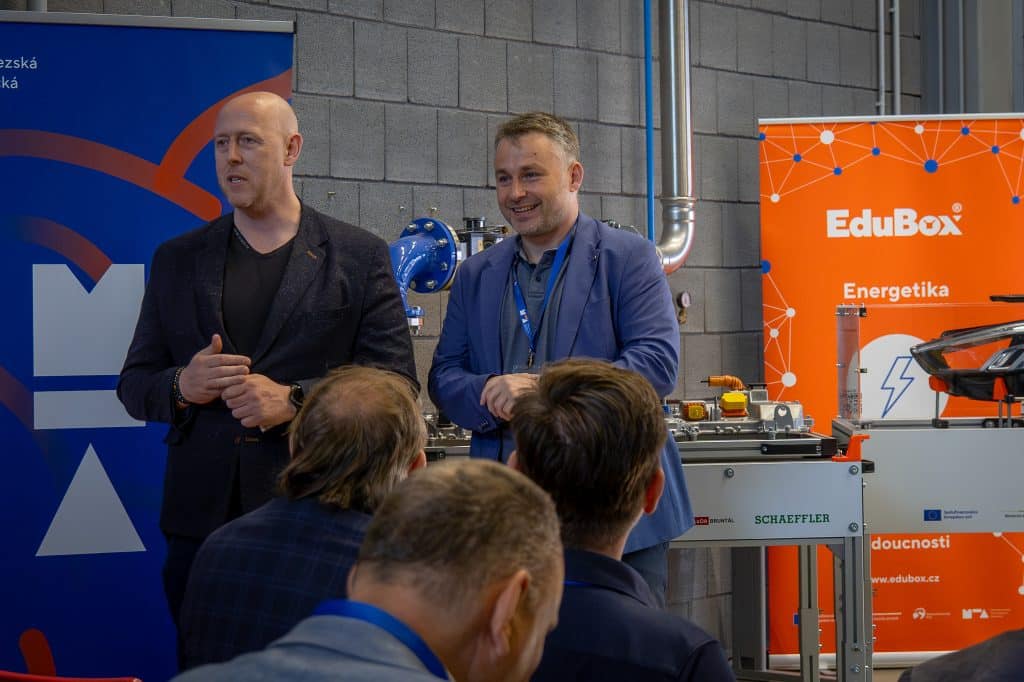
Modern technologies are transforming industry, energy, and transportation. To help secondary schools keep pace with these changes, the Future Mobility and Energy Roundtable was held on June 2, 2026, at CEET, VSB – Technical University of Ostrava. The event brought together more than 40 teachers, experts, and school representatives to explore ways of integrating the latest industry knowledge into education and preparing students for the professions of the future.
The event was traditionally opened by Jan Veřmiřovský, Deputy Governor of the Moravian-Silesian Region for Education, who emphasized the importance of supporting vocational education in modern technological fields and preparing students for the rapidly changing demands of the labor market.
The Future Mobility team presented innovations developed over the past year, including new headlamp visualizations, the OneBox system, and educational materials focused on ADAS (Advanced Driver Assistance Systems), camera technologies, and sensors used in modern vehicles. The presentation also included information about specialized training programs and teaching aids available for educators.
The Energy team, led by Petr Vavřiňák and Tomáš Kostka, made its debut at the roundtable. They introduced upcoming EduBoxes and key topics for classroom instruction. Participants learned about transformer principles, fundamental electrical quantities, and other important areas of contemporary energy systems.
One of the highlights of the event was a presentation by Martin Kavan, Head of the Future Mobility Team, focusing on the use of hydrogen in transportation and energy systems. Hydrogen technologies currently represent one of the most exciting intersections between these two fields.
The program also included a guided tour of the CEET facilities, which are among the most advanced research and development centers in the Czech Republic.
The roundtable once again demonstrated that cooperation between schools, industry experts, and companies is essential to ensuring that modern technologies are introduced into education in a timely manner and in line with real-world needs. The integration of mobility, energy, and education is opening new opportunities for schools and future generations of technically skilled students.